Opening Hook
According to the United Nations, the world's population is projected to reach 9.7 billion by 2050, placing unprecedented pressure on global food production. To meet this demand, agricultural productivity must increase by 70% over the next three decades. Enter Artificial Intelligence (AI), a transformative technology that is revolutionizing precision agriculture and crop yield optimization. By leveraging AI, farmers can make data-driven decisions, reduce waste, and enhance overall efficiency, ultimately ensuring food security for future generations.
Industry Context and Market Dynamics
The global precision agriculture market was valued at $6.38 billion in 2021 and is expected to grow at a CAGR of 12.7% from 2022 to 2030, reaching $16.8 billion by 2030. This growth is driven by the increasing need for sustainable farming practices, the rising adoption of IoT and AI technologies, and the growing demand for high-yield crops. Key pain points in the industry include inefficient resource management, unpredictable weather patterns, and the need for real-time data to optimize crop yields. Companies like John Deere, IBM, and startups such as CropX and FarmWise are leading the charge in addressing these challenges through innovative AI solutions.
The competitive landscape is diverse, with established players and startups vying for market share. Large corporations like John Deere and IBM have the advantage of extensive resources and existing customer bases, while startups bring agility and cutting-edge technology. The key differentiators in this market include the ability to provide actionable insights, seamless integration with existing farm systems, and the provision of end-to-end solutions that address multiple aspects of farm management.
In-Depth Case Studies
Case Study 1: John Deere - Precision Planting and Yield Optimization
John Deere, a leader in agricultural machinery, has integrated AI into its precision planting solutions. The company's ExactEmerge planter uses machine learning algorithms to optimize seed placement, depth, and spacing. By analyzing soil conditions, historical data, and real-time sensor inputs, the system ensures that each seed is planted in the most optimal environment. This solution has been implemented across thousands of farms, resulting in a 5-10% increase in crop yields. For example, a 1,000-acre corn farm in Iowa saw a 7% yield increase, translating to an additional $20,000 in revenue per year. The implementation timeline typically ranges from 2-3 months, including installation, calibration, and training.
Case Study 2: IBM - Weather-Driven Crop Management
IBM's Watson Decision Platform for Agriculture leverages AI to provide hyper-local weather forecasts and predictive analytics. The platform integrates data from various sources, including satellite imagery, weather stations, and soil sensors, to deliver actionable insights to farmers. One of the key features is the ability to predict and mitigate the impact of adverse weather conditions on crops. In a pilot project in Kenya, farmers using the platform were able to reduce crop losses due to weather events by 25%. Additionally, the platform helped farmers save up to 20% on water usage by optimizing irrigation schedules. The implementation process, which includes data collection, model training, and user training, typically takes 3-6 months.
Case Study 3: CropX - Soil Health and Water Management
CropX, a startup specializing in soil health and water management, has developed an AI-powered platform that uses in-ground sensors and machine learning to provide real-time insights into soil moisture, temperature, and nutrient levels. The platform helps farmers optimize irrigation, reduce water usage, and improve crop yields. In a case study with a 500-acre almond farm in California, the use of CropX's platform led to a 30% reduction in water usage and a 15% increase in yield. The implementation process, which includes sensor installation, data collection, and system integration, typically takes 1-2 months. The platform's subscription-based model makes it accessible to both small and large-scale farmers.
Technical Implementation Insights
The key AI technologies used in these case studies include machine learning algorithms, computer vision, and natural language processing. For instance, John Deere's ExactEmerge planter uses supervised learning algorithms to predict the optimal planting parameters based on historical and real-time data. IBM's Watson Decision Platform for Agriculture employs deep learning models to analyze satellite imagery and generate hyper-local weather forecasts. CropX's platform utilizes unsupervised learning to detect anomalies in soil data and provide recommendations for corrective actions.
Implementation challenges often include data quality and availability, system integration, and user adoption. To address these, companies invest in robust data collection and cleaning processes, develop APIs for seamless integration with existing farm systems, and provide comprehensive training and support to farmers. Performance metrics, such as accuracy, precision, and response time, are continuously monitored and benchmarked to ensure the effectiveness of the AI solutions.
Business Impact and ROI Analysis
The business benefits of AI in precision agriculture are substantial. For example, John Deere's customers have reported a 5-10% increase in crop yields, leading to significant revenue gains. IBM's platform has helped farmers reduce crop losses by 25%, resulting in cost savings and improved profitability. CropX's solution has enabled a 30% reduction in water usage, contributing to both environmental sustainability and cost efficiency. The return on investment (ROI) for these solutions is typically realized within 1-2 years, making them attractive to both small and large-scale farmers.
Market adoption trends indicate a growing acceptance of AI in agriculture, with more farmers recognizing the value of data-driven decision-making. Competitive advantages gained from AI include increased operational efficiency, reduced resource waste, and enhanced crop yields. As the technology continues to evolve, the ROI is expected to improve, further driving adoption and market growth.
Challenges and Limitations
Despite the numerous benefits, the implementation of AI in agriculture faces several challenges. Technical limitations, such as the need for high-quality data and the complexity of AI models, can hinder adoption. Regulatory and ethical considerations, including data privacy and the potential for job displacement, also pose significant hurdles. Industry-specific obstacles, such as the variability of weather and soil conditions, require continuous adaptation and refinement of AI models.
For example, the accuracy of weather predictions and soil analysis can be affected by the quality and quantity of available data. Ensuring the reliability and consistency of data is crucial for the success of AI solutions. Additionally, the high initial investment required for AI technology can be a barrier for small-scale farmers, limiting their access to these benefits.
Future Outlook and Trends
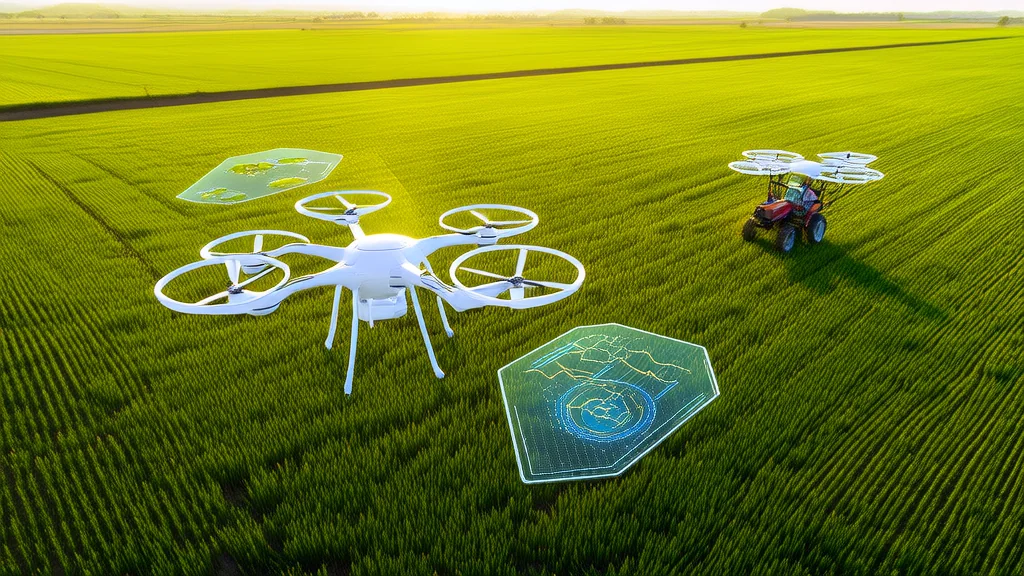
Emerging trends in AI for agriculture include the integration of AI with other advanced technologies, such as robotics and drones, to create fully autonomous farming systems. Predictive analytics and prescriptive analytics are becoming more sophisticated, enabling farmers to not only predict but also prescribe actions to optimize crop yields. Over the next 2-3 years, we can expect to see increased adoption of AI in precision agriculture, driven by the need for sustainable and efficient farming practices.
Potential new applications include the use of AI in pest and disease management, where machine learning models can detect and predict outbreaks, allowing for timely intervention. Investment in AI for agriculture is expected to grow, with venture capital and private equity firms increasingly backing startups in this space. The market for AI in agriculture is projected to continue its strong growth trajectory, with a CAGR of 12.7% from 2022 to 2030, reaching $16.8 billion by 2030.
As the agricultural sector continues to embrace AI, the potential for innovation and improvement is vast. By leveraging the power of AI, farmers can not only meet the growing demand for food but also do so in a sustainable and efficient manner, ensuring a brighter future for all.