Introduction and Context
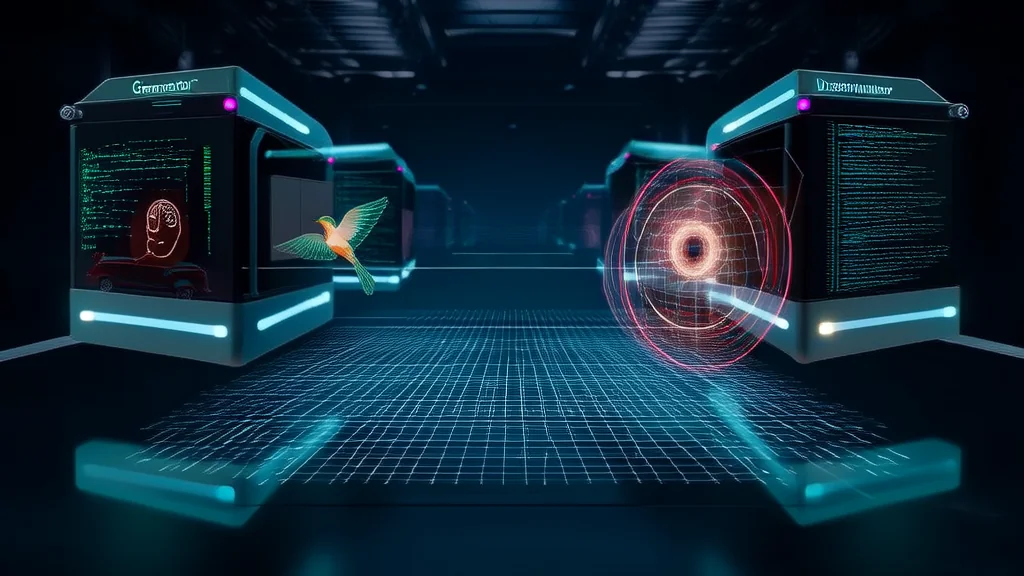
Generative Adversarial Networks (GANs) are a class of machine learning models that have revolutionized the field of generative modeling. Introduced by Ian Goodfellow and his colleagues in 2014, GANs consist of two neural networks: a generator and a discriminator. The generator creates data that mimics real data, while the discriminator evaluates whether the generated data is real or fake. The two networks are trained simultaneously in a zero-sum game, where the generator tries to fool the discriminator, and the discriminator tries to distinguish between real and fake data. This adversarial training process leads to the generator producing increasingly realistic data.
GANs have become a cornerstone in the field of deep learning due to their ability to generate high-quality, realistic data. They address the challenge of generating new, unseen data that is similar to a given dataset. This capability has significant implications for various applications, including image synthesis, style transfer, and data augmentation. GANs have been particularly impactful in areas where traditional generative models, such as Variational Autoencoders (VAEs), struggle to produce high-fidelity results. The development of GANs marked a turning point in the field, enabling more sophisticated and versatile generative models.
Core Concepts and Fundamentals
The fundamental principle behind GANs is the adversarial training process, which involves two neural networks: the generator \(G\) and the discriminator \(D\). The generator takes random noise \(z\) as input and generates synthetic data \(G(z)\). The discriminator, on the other hand, takes both real data \(x\) from the training set and synthetic data \(G(z)\) and outputs a probability indicating whether the input is real or fake. The goal of the generator is to produce data that the discriminator cannot distinguish from real data, while the discriminator aims to correctly classify real and fake data.
The key mathematical concept in GANs is the minimax game, where the generator and discriminator compete against each other. The objective function, known as the value function \(V(D, G)\), is defined as:
V(D, G) = E[log D(x)] + E[log(1 - D(G(z)))]
Here, \(E\) denotes the expected value, \(x\) is a sample from the real data distribution, and \(z\) is a sample from the noise distribution. The first term encourages the discriminator to maximize the probability of correctly classifying real data, while the second term encourages the generator to minimize the probability of the discriminator correctly classifying the generated data as fake.
The core components of a GAN are the generator and the discriminator. The generator is typically a deep neural network that maps a random noise vector to a synthetic data sample. The discriminator is another deep neural network that takes a data sample and outputs a scalar value representing the probability that the sample is real. The roles of these components are complementary: the generator learns to create data that is indistinguishable from real data, and the discriminator learns to distinguish between real and fake data.
Compared to related technologies like VAEs, GANs offer several advantages. VAEs aim to learn an explicit mapping from the data space to a latent space and back, which can sometimes lead to blurry or less realistic generated samples. GANs, on the other hand, focus on generating data that is indistinguishable from real data, often resulting in sharper and more realistic samples. However, GANs can be more challenging to train and may suffer from issues like mode collapse, where the generator produces a limited variety of outputs.
Technical Architecture and Mechanics
The architecture of a GAN consists of two main components: the generator and the discriminator. The generator \(G\) is a neural network that takes a random noise vector \(z\) as input and outputs a synthetic data sample \(G(z)\). The discriminator \(D\) is another neural network that takes a data sample \(x\) as input and outputs a scalar value \(D(x)\) representing the probability that the sample is real.
The training process of a GAN is iterative and involves alternating updates to the generator and the discriminator. The steps are as follows:
- Initialize the Generator and Discriminator: Start with randomly initialized weights for both the generator and the discriminator.
- Train the Discriminator: For a batch of real data \(x\) and a batch of generated data \(G(z)\), update the discriminator's parameters to maximize the value function \(V(D, G)\). This is done using gradient ascent on the discriminator's loss function.
- Train the Generator: For a batch of generated data \(G(z)\), update the generator's parameters to minimize the value function \(V(D, G)\). This is done using gradient descent on the generator's loss function.
- Repeat Steps 2 and 3: Continue alternating between training the discriminator and the generator until convergence or a stopping criterion is met.
Key design decisions in GANs include the choice of architecture for the generator and discriminator, the type of loss function used, and the method for updating the parameters. For example, the generator and discriminator can be designed using different types of neural networks, such as fully connected networks, convolutional neural networks (CNNs), or recurrent neural networks (RNNs). The loss function can be the standard cross-entropy loss or a modified version, such as the Wasserstein loss, which has been shown to improve training stability.
For instance, in the original GAN paper, the generator and discriminator were both designed using fully connected networks. In subsequent works, CNNs have become the standard choice for image generation tasks due to their ability to capture spatial hierarchies in the data. The use of CNNs in the generator and discriminator, as seen in the Deep Convolutional GAN (DCGAN), has led to significant improvements in the quality of generated images.
Technical innovations in GANs include the introduction of techniques like feature matching, which encourages the generator to match the statistics of the real data, and the use of label information in Conditional GANs (cGANs), which allows for the generation of data conditioned on specific attributes. These innovations have addressed some of the challenges in GAN training, such as mode collapse and instability, and have led to more robust and versatile models.
Advanced Techniques and Variations
Since their introduction, GANs have evolved significantly, with numerous variations and improvements. One of the most notable advancements is the StyleGAN series, which includes StyleGAN, StyleGAN2, and StyleGAN3. These models have achieved state-of-the-art performance in generating high-resolution, photorealistic images.
StyleGAN introduces a novel architecture that separates the generation of high-level features (e.g., pose, shape) from low-level details (e.g., texture, color). This is achieved through a style-based generator, which uses adaptive instance normalization (AdaIN) to inject style information at multiple levels of the network. This approach allows for better control over the generated images and enables the manipulation of specific attributes, such as changing the hairstyle or age of a face.
StyleGAN2 further improves upon StyleGAN by addressing some of its limitations, such as artifacts and inconsistencies in the generated images. It introduces a path length regularization technique, which ensures that small changes in the input noise result in small changes in the output, leading to more stable and consistent generation. Additionally, StyleGAN2 uses a progressive growing strategy, where the generator and discriminator are trained on progressively higher resolutions, allowing for more efficient and effective training.
Recent research developments in GANs include the use of self-supervised learning and contrastive learning to improve the representation learning capabilities of GANs. For example, Contrastive Unpaired Translation (CUT) GANs use contrastive learning to learn a mapping between unpaired data domains, such as translating images from one style to another without paired examples. Another approach is the use of normalizing flows in GANs, which allow for more flexible and expressive generative models by transforming a simple distribution into a complex one through a series of invertible transformations.
Different approaches to GANs have their trade-offs. For instance, while StyleGAN and its variants excel in generating high-quality images, they require significant computational resources and may not be suitable for all applications. On the other hand, simpler GAN architectures, such as DCGAN, are more computationally efficient but may produce lower-quality results. The choice of GAN variant depends on the specific requirements of the task, such as the desired resolution, the available computational resources, and the need for fine-grained control over the generated data.
Practical Applications and Use Cases
GANs have found a wide range of practical applications across various domains. One of the most prominent applications is in image synthesis, where GANs are used to generate realistic images for tasks such as data augmentation, image editing, and content creation. For example, NVIDIA's StyleGAN and StyleGAN2 are widely used in the entertainment industry for generating high-quality, photorealistic faces and scenes. These models have also been applied in the fashion industry for creating virtual clothing and in the automotive industry for designing car interiors and exteriors.
Another important application of GANs is in style transfer, where the goal is to transfer the style of one image to another. This is achieved using Conditional GANs (cGANs), which condition the generator on both the content and style images. For instance, CycleGAN, a popular cGAN variant, can translate images from one domain to another, such as converting a photograph into a painting in the style of a specific artist. This has applications in art, design, and creative content generation.
GANs are also used in data augmentation, where they generate additional training data to improve the performance of machine learning models. This is particularly useful in scenarios where labeled data is scarce or expensive to obtain. For example, in medical imaging, GANs can generate synthetic images of tumors or other abnormalities, which can be used to augment the training set and improve the accuracy of diagnostic models. Similarly, in natural language processing, GANs can be used to generate synthetic text data for training language models, as seen in the work on Text-to-Image Synthesis with Stacked GANs.
What makes GANs suitable for these applications is their ability to generate high-quality, diverse, and realistic data. GANs can learn complex data distributions and generate samples that are indistinguishable from real data, making them ideal for tasks that require high-fidelity and variability. However, the performance of GANs in practice can vary depending on the specific implementation and the quality of the training data. Careful tuning of the model architecture and training parameters is often necessary to achieve the best results.
Technical Challenges and Limitations
Despite their success, GANs face several technical challenges and limitations. One of the primary challenges is the difficulty in training GANs, which can be unstable and prone to issues like mode collapse, where the generator produces a limited variety of outputs, and vanishing gradients, where the gradients become too small to effectively update the parameters. These issues can lead to poor quality or non-diverse generated data.
Computational requirements are another significant challenge. Training GANs, especially high-resolution image generators like StyleGAN, requires substantial computational resources, including powerful GPUs and large amounts of memory. This can make GANs impractical for many applications, particularly those with limited computational budgets. Additionally, the training time for GANs can be long, often requiring days or even weeks to converge, which can be a bottleneck in rapid prototyping and experimentation.
Scalability is also a concern. As the size and complexity of the data increase, the difficulty of training GANs grows. Large-scale datasets, such as those used in video generation or 3D modeling, can be particularly challenging to handle with GANs. Techniques like progressive growing, which incrementally increases the resolution during training, can help, but they still require significant computational resources.
Research directions addressing these challenges include the development of more stable and efficient training algorithms, such as the use of alternative loss functions like the Wasserstein distance, and the exploration of new architectures and techniques, such as self-attention mechanisms and normalizing flows. Additionally, there is ongoing work on reducing the computational requirements of GANs, such as through the use of more efficient network architectures and hardware acceleration. These efforts aim to make GANs more accessible and practical for a wider range of applications.
Future Developments and Research Directions
Emerging trends in GANs include the integration of GANs with other machine learning paradigms, such as reinforcement learning and unsupervised learning. For example, GANs can be used to generate realistic environments for training reinforcement learning agents, or to learn disentangled representations of data in an unsupervised manner. These hybrid approaches have the potential to unlock new applications and improve the performance of existing models.
Active research directions in GANs include the development of more interpretable and controllable GANs, where the user can have finer control over the generated data. Techniques like conditional generation, style transfer, and attribute manipulation are being explored to enable more precise and targeted data generation. Additionally, there is a growing interest in the ethical and social implications of GANs, such as the potential for misuse in generating fake news, deepfakes, and other forms of misinformation. Researchers are working on developing methods to detect and mitigate the risks associated with GAN-generated content.
Potential breakthroughs on the horizon include the development of GANs that can generate high-fidelity data in real-time, which could have significant implications for applications like augmented reality and interactive content creation. Another area of interest is the use of GANs in scientific discovery, where they can be used to generate and explore new chemical compounds, materials, and biological structures. These applications could lead to new insights and innovations in fields such as drug discovery, materials science, and biotechnology.
From an industry perspective, GANs are expected to continue to play a crucial role in content creation, data augmentation, and synthetic data generation. Companies are investing in GAN research and development to leverage their capabilities in areas such as media production, advertising, and personalized content. From an academic perspective, GANs remain a vibrant area of research, with ongoing efforts to improve their stability, efficiency, and applicability to a broader range of problems. The future of GANs is likely to be shaped by a combination of theoretical advancements, practical innovations, and ethical considerations, making them a key technology in the evolving landscape of AI and machine learning.