Opening Hook
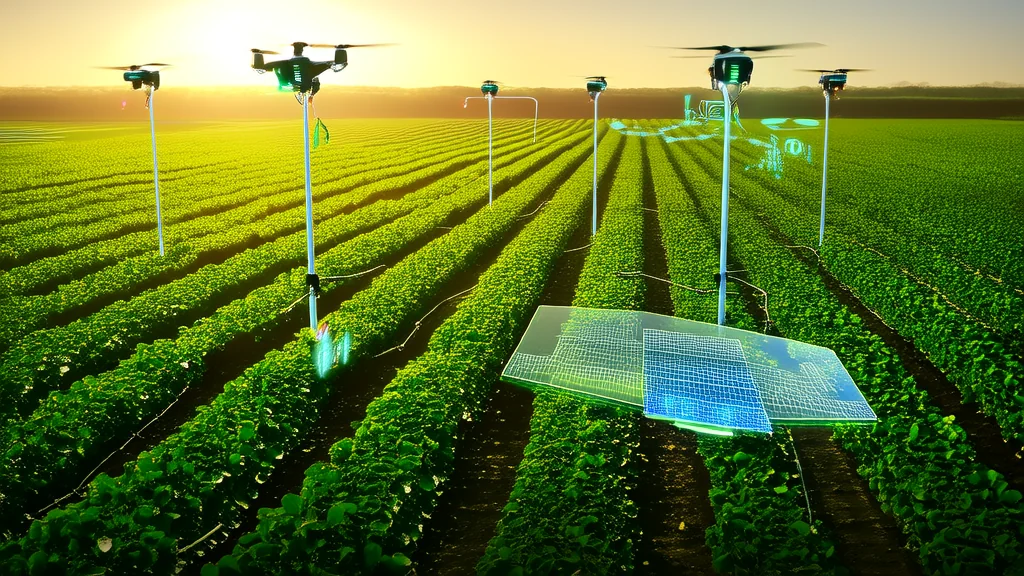
According to the United Nations, the world's population is projected to reach 9.7 billion by 2050, placing unprecedented pressure on global food production. To meet this demand, the agricultural sector must become more efficient and sustainable. Artificial Intelligence (AI) is emerging as a key enabler in this transformation, offering solutions that can significantly enhance crop yields and optimize resource use. This article delves into how AI is revolutionizing precision agriculture, focusing on real-world case studies and their business impact.
Industry Context and Market Dynamics
The agricultural industry is undergoing a technological renaissance, driven by the need for higher efficiency and sustainability. The global precision agriculture market was valued at $6.38 billion in 2021 and is expected to grow at a CAGR of 13.5% from 2022 to 2030, reaching $17.5 billion by 2030. Key pain points in the industry include inefficient use of resources, labor shortages, and the need for more accurate and timely data to make informed decisions. AI addresses these challenges by providing predictive analytics, automated decision-making, and real-time monitoring capabilities.
The competitive landscape is diverse, with both established tech giants and innovative startups vying for market share. Companies like John Deere, IBM, and Microsoft are leveraging their existing technology stacks to offer AI-driven solutions, while startups such as CropX and FarmWise are developing specialized AI tools tailored to specific agricultural needs.
In-Depth Case Studies
Case Study 1: John Deere and Blue River Technology
John Deere, a leading manufacturer of agricultural machinery, acquired Blue River Technology in 2017. Blue River developed an AI-powered system called "See & Spray," which uses computer vision and machine learning to identify and target weeds in real time. This solution reduces herbicide use by up to 90%, significantly lowering costs and environmental impact.
Specific Problem: Traditional weed control methods often involve blanket spraying, which is inefficient and harmful to the environment.
AI Solution: See & Spray uses high-resolution cameras and deep learning algorithms to differentiate between crops and weeds. The system then applies herbicides only to the weeds, using precise spray nozzles.
Measurable Results: In trials, See & Spray reduced herbicide use by 90%, saving farmers an average of $20 per acre. The system also improved crop yield by 5-10% due to more effective weed control.
Timeline and Implementation Details: The acquisition was completed in 2017, and See & Spray was integrated into John Deere's product line. Field trials began in 2018, and the system was commercially available by 2020.
Case Study 2: Microsoft and Azure FarmBeats
Microsoft’s Azure FarmBeats is a platform that leverages AI and IoT to provide data-driven insights for precision agriculture. The platform collects data from various sources, including drones, satellites, and ground sensors, and uses machine learning to analyze and provide actionable recommendations.
Specific Problem: Farmers lacked a comprehensive, easy-to-use platform to collect and analyze data from multiple sources, leading to suboptimal decision-making.
AI Solution: Azure FarmBeats integrates data from different sources and uses AI models to predict soil moisture, nutrient levels, and crop health. The platform provides real-time alerts and recommendations, enabling farmers to take proactive measures.
Measurable Results: In a pilot project with a large-scale farm in the U.S., Azure FarmBeats improved water usage efficiency by 20%, resulting in a 15% increase in crop yield. The platform also reduced operational costs by 10% through optimized resource allocation.
Timeline and Implementation Details: Azure FarmBeats was launched in 2018, and the pilot project with the U.S. farm began in 2019. The platform was fully integrated into the farm's operations by 2020, and it has since been adopted by several other farms globally.
Case Study 3: CropX and Soil Health Monitoring
CropX, an Israeli startup, specializes in soil health monitoring and management. Their AI-powered platform uses wireless sensors to collect data on soil moisture, temperature, and nutrient levels. The data is analyzed using machine learning algorithms to provide precise irrigation and fertilization recommendations.
Specific Problem: Inefficient water and fertilizer use led to high operational costs and environmental degradation.
AI Solution: CropX's platform uses wireless sensors and cloud-based analytics to monitor soil conditions in real time. The AI algorithms generate personalized irrigation and fertilization schedules, optimizing water and nutrient use.
Measurable Results: In a study conducted in California, CropX's platform reduced water usage by 25% and fertilizer application by 20%, resulting in a 10% increase in crop yield. The platform also provided a 20% reduction in operational costs.
Timeline and Implementation Details: CropX was founded in 2015, and the platform was commercially available by 2017. The California study was conducted in 2018, and the platform has since been adopted by over 1,000 farms worldwide.
Technical Implementation Insights
The AI technologies used in these case studies include computer vision, machine learning, and IoT. For example, Blue River's See & Spray uses convolutional neural networks (CNNs) for image recognition, while Microsoft's Azure FarmBeats employs recurrent neural networks (RNNs) for time-series data analysis. CropX's platform utilizes random forest and gradient boosting algorithms for predictive modeling.
Implementation challenges include data integration, model training, and real-time processing. Solutions include using cloud-based platforms for scalable computing, employing edge computing for real-time data processing, and leveraging pre-trained models for faster deployment. Integration with existing systems, such as farm management software and equipment, is crucial for seamless adoption. Performance metrics, such as accuracy, precision, and recall, are used to benchmark the effectiveness of AI models.
Business Impact and ROI Analysis
The business benefits of AI in precision agriculture are substantial. In the case of John Deere and Blue River, the See & Spray system not only reduced herbicide use but also increased crop yield, resulting in a significant return on investment. Similarly, Microsoft's Azure FarmBeats and CropX's platform have demonstrated cost savings and yield improvements, providing a clear ROI for farmers. Market adoption trends indicate a growing acceptance of AI-driven solutions, with more farmers recognizing the value of data-driven decision-making.
Competitive advantages gained from AI include higher efficiency, lower operational costs, and improved sustainability. For instance, John Deere's See & Spray system gives them a competitive edge in the precision agriculture market, while Microsoft and CropX are positioning themselves as leaders in data-driven farming solutions.
Challenges and Limitations
Despite the numerous benefits, implementing AI in agriculture comes with its challenges. Technical limitations include the need for high-quality, labeled data for training AI models and the complexity of integrating AI with existing farm infrastructure. Regulatory and ethical considerations, such as data privacy and the potential for job displacement, also need to be addressed. Additionally, the high initial cost of AI solutions and the need for technical expertise can be barriers to adoption, particularly for small and medium-sized farms.
Industry-specific obstacles include the variability of weather conditions, which can affect the accuracy of AI predictions, and the need for robust, durable hardware that can withstand harsh field conditions. Addressing these challenges requires a collaborative approach involving stakeholders from the agricultural, technological, and regulatory sectors.
Future Outlook and Trends
Emerging trends in AI for precision agriculture include the use of advanced sensors, such as hyperspectral imaging, and the integration of AI with robotics for automated farming tasks. Predictions for the next 2-3 years suggest a continued growth in the adoption of AI-driven solutions, with a focus on improving the accuracy and reliability of AI models. Potential new applications include the use of AI for pest and disease detection, climate change adaptation, and supply chain optimization.
Investment and market growth projections are optimistic, with increasing interest from venture capitalists and tech companies. The global precision agriculture market is expected to see significant growth, driven by the need for more efficient and sustainable farming practices. As AI technology continues to evolve, the agricultural sector is poised to benefit from further innovations, leading to a more resilient and productive food system.