Opening Hook
In 2022, the global transportation and logistics industry was valued at over $9 trillion, with a projected CAGR of 5.5% from 2023 to 2028. Despite this growth, the industry faces significant challenges, including rising fuel costs, labor shortages, and increasing customer expectations for faster and more reliable delivery. Artificial Intelligence (AI) is emerging as a transformative force in this domain, offering solutions that can optimize routes, reduce operational costs, and enhance overall efficiency. For instance, AI-powered route optimization can reduce fuel consumption by up to 15%, while autonomous vehicle systems can cut labor costs by 30%. This article delves into how AI is reshaping the transportation and logistics landscape, focusing on real-world case studies and their business impact.
Industry Context and Market Dynamics
The transportation and logistics industry is a critical component of the global economy, encompassing everything from freight forwarding and warehousing to last-mile delivery. The sector is under immense pressure to become more efficient, sustainable, and cost-effective. Key pain points include high fuel costs, inefficient routing, and the need for real-time visibility and tracking. AI addresses these issues by providing advanced analytics, predictive modeling, and automation capabilities.
The market for AI in transportation and logistics is growing rapidly. According to a report by MarketsandMarkets, the global AI in the transportation market is expected to reach $3.5 billion by 2026, up from $1.7 billion in 2021. Major players in this space include tech giants like Google, Microsoft, and Amazon, as well as innovative startups such as Nuro and Embark. These companies are leveraging AI to create smarter, more efficient, and more sustainable transportation solutions.
In-Depth Case Studies
Case Study 1: UPS - Route Optimization with ORION
UPS, one of the world's largest package delivery companies, faced the challenge of optimizing its delivery routes to reduce fuel consumption and improve on-time delivery rates. In 2013, UPS introduced ORION (On-Road Integrated Optimization and Navigation), an AI-powered route optimization system. ORION uses advanced algorithms to analyze multiple data points, including traffic patterns, weather conditions, and delivery locations, to determine the most efficient routes for each driver.
Technical Implementation: ORION utilizes machine learning algorithms, specifically reinforcement learning, to continuously learn and adapt to changing conditions. The system integrates with UPS's existing fleet management software, allowing for seamless implementation and minimal disruption to operations.
Results: Since the introduction of ORION, UPS has seen a 10% reduction in miles driven, leading to a 10 million gallon reduction in fuel consumption annually. Additionally, on-time delivery rates have improved, and the company has saved approximately $300-400 million in operational costs per year. The system was rolled out gradually, with full implementation achieved by 2018.
Case Study 2: Waymo - Autonomous Vehicle Systems
Waymo, a subsidiary of Alphabet Inc., is a leader in the development of autonomous vehicle technology. The company's primary goal is to create a safer, more efficient, and more accessible transportation system. One of the key applications of Waymo's technology is in the logistics sector, where autonomous vehicles can be used for long-haul trucking and last-mile delivery.
Specific Problem: Long-haul trucking is a critical but challenging part of the logistics chain, often plagued by driver shortages and high labor costs. Waymo's autonomous trucks aim to address these issues by providing a reliable and cost-effective alternative.
AI Solution: Waymo's autonomous driving system uses a combination of sensors, cameras, and LiDAR to create a detailed 3D map of the environment. Machine learning algorithms, including deep neural networks, process this data in real-time to make decisions about steering, braking, and acceleration. The system is designed to handle a wide range of driving scenarios, from urban streets to highways.
Results: Waymo's autonomous trucks have already completed over 20 billion miles of simulation and 20 million miles of real-world testing. The company has partnered with several logistics firms, including J.B. Hunt and DHL, to pilot its autonomous trucking solution. Early results indicate that autonomous trucks can reduce operating costs by up to 45% and increase delivery capacity by 20-30%. The timeline for full commercial deployment is still being finalized, but Waymo aims to have a significant number of autonomous trucks on the road by 2025.
Case Study 3: Convoy - Dynamic Pricing and Load Matching
Convoy, a Seattle-based startup, is revolutionizing the freight brokerage industry with its AI-powered platform. The company's primary focus is on improving the efficiency of load matching and pricing, which are traditionally time-consuming and manual processes.
Specific Problem: The traditional freight brokerage model is highly fragmented and inefficient, with brokers spending hours on the phone to match loads with carriers. This leads to higher costs and longer wait times for both shippers and carriers.
AI Solution: Convoy's platform uses machine learning algorithms to dynamically price and match loads in real-time. The system analyzes a wide range of data points, including historical pricing, current market conditions, and carrier availability, to provide accurate and competitive rates. Additionally, the platform uses natural language processing (NLP) to automate communication between shippers and carriers, reducing the need for human intervention.
Results: Since launching in 2015, Convoy has seen rapid adoption, with over 1,000 shippers and 100,000 carriers using the platform. The company has reduced the time it takes to match a load with a carrier from hours to minutes, resulting in a 30% reduction in empty miles and a 20% increase in carrier utilization. Convoy's dynamic pricing model has also led to a 15% reduction in shipping costs for shippers. The platform was developed and deployed over a period of two years, with continuous improvements and updates based on user feedback and performance data.
Technical Implementation Insights
The AI technologies used in the transportation and logistics industry vary depending on the specific application. For route optimization, algorithms such as Dijkstra's algorithm and A* search are commonly used, along with more advanced techniques like reinforcement learning. Autonomous vehicle systems rely heavily on computer vision, sensor fusion, and deep learning models, particularly convolutional neural networks (CNNs) and recurrent neural networks (RNNs).
Implementation challenges include integrating AI systems with existing infrastructure, ensuring data quality and security, and addressing regulatory and safety concerns. For example, Waymo had to overcome significant technical hurdles to ensure that its autonomous trucks could safely navigate complex and dynamic environments. This involved extensive testing and validation, as well as close collaboration with regulators to obtain the necessary approvals.
Performance metrics for AI in transportation and logistics include accuracy, response time, and reliability. For route optimization, key metrics include the percentage reduction in miles driven, fuel savings, and on-time delivery rates. For autonomous vehicle systems, metrics such as mean time between failures (MTBF) and collision avoidance rates are crucial. Continuous monitoring and benchmarking are essential to ensure that AI systems meet or exceed these performance standards.
Business Impact and ROI Analysis
The business benefits of AI in transportation and logistics are substantial. Companies like UPS and Convoy have realized significant cost savings and operational efficiencies through the use of AI. For example, UPS's ORION system has saved the company hundreds of millions of dollars in operational costs, while Convoy's platform has reduced shipping costs by 15% for shippers. These cost savings can be reinvested in other areas of the business, such as expanding service offerings or improving customer experience.
Return on investment (ROI) for AI projects in this domain is typically high, with many companies seeing a payback period of less than two years. For instance, Waymo's autonomous trucking solution is expected to generate a 45% reduction in operating costs, leading to a quick ROI for early adopters. Market adoption trends are also positive, with an increasing number of companies investing in AI-powered solutions to stay competitive and meet the demands of a rapidly evolving market.
Challenges and Limitations
Despite the many benefits, the implementation of AI in transportation and logistics is not without challenges. Technical limitations, such as the need for large amounts of high-quality data and the complexity of AI algorithms, can be significant barriers. Additionally, regulatory and ethical considerations, such as data privacy and liability for autonomous vehicles, must be carefully addressed. For example, Waymo had to navigate a complex regulatory landscape to obtain the necessary permits and certifications for its autonomous trucks.
Industry-specific obstacles include the need for robust and secure communication networks, especially for real-time data transmission. Infrastructure limitations, such as the lack of adequate charging stations for electric vehicles, can also hinder the adoption of new technologies. Addressing these challenges requires a multi-faceted approach, involving collaboration between technology providers, industry stakeholders, and policymakers.
Future Outlook and Trends
The future of AI in transportation and logistics is promising, with several emerging trends and potential new applications. One key trend is the integration of AI with other emerging technologies, such as the Internet of Things (IoT) and 5G networks, to create more connected and intelligent transportation systems. For example, IoT sensors can provide real-time data on vehicle performance and environmental conditions, which can be used to further optimize routes and improve safety.
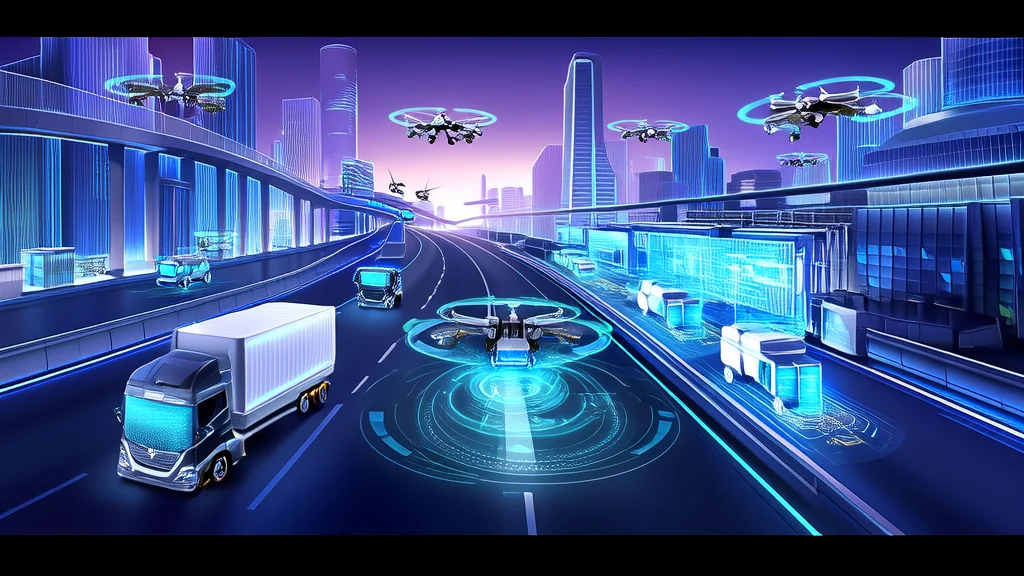
Predictions for the next 2-3 years include the widespread adoption of autonomous vehicles for both passenger and freight transport. Investment in this area is expected to continue to grow, with a projected market size of $1.5 trillion by 2030. New applications, such as drone delivery and smart warehouses, are also on the horizon, offering even more opportunities for innovation and efficiency. As the industry continues to evolve, AI will play a central role in driving these advancements and shaping the future of transportation and logistics.