Introduction and Context
Multimodal AI is a subfield of artificial intelligence that focuses on the integration and processing of multiple types of data, such as text, images, and audio. This technology enables machines to understand and generate content across different modalities, thereby providing a more holistic and contextually rich understanding of the world. The importance of multimodal AI lies in its ability to mimic human perception, which naturally processes information from multiple sources simultaneously. For example, when we read a book, we not only process the text but also visualize the scenes and hear the characters' voices in our minds.
The development of multimodal AI has been a gradual process, with significant milestones in the past decade. One of the key breakthroughs was the introduction of CLIP (Contrastive Language-Image Pre-training) by OpenAI in 2021, which demonstrated the power of joint training on text and image data. Prior to this, most AI systems were unimodal, focusing on one type of data at a time. Multimodal AI addresses the technical challenge of aligning and integrating diverse data types, enabling more robust and versatile AI applications. This technology is particularly important for tasks that require a deep understanding of context, such as visual question answering, cross-modal retrieval, and multimodal dialogue systems.
Core Concepts and Fundamentals
The fundamental principle underlying multimodal AI is the idea that different types of data can provide complementary information. For example, an image can provide visual context that text alone cannot, and vice versa. The key mathematical concept in multimodal AI is the use of shared embedding spaces, where different modalities are mapped into a common vector space. This allows for the comparison and alignment of data across modalities. Intuitively, this is like translating different languages into a universal language that can be understood by all.
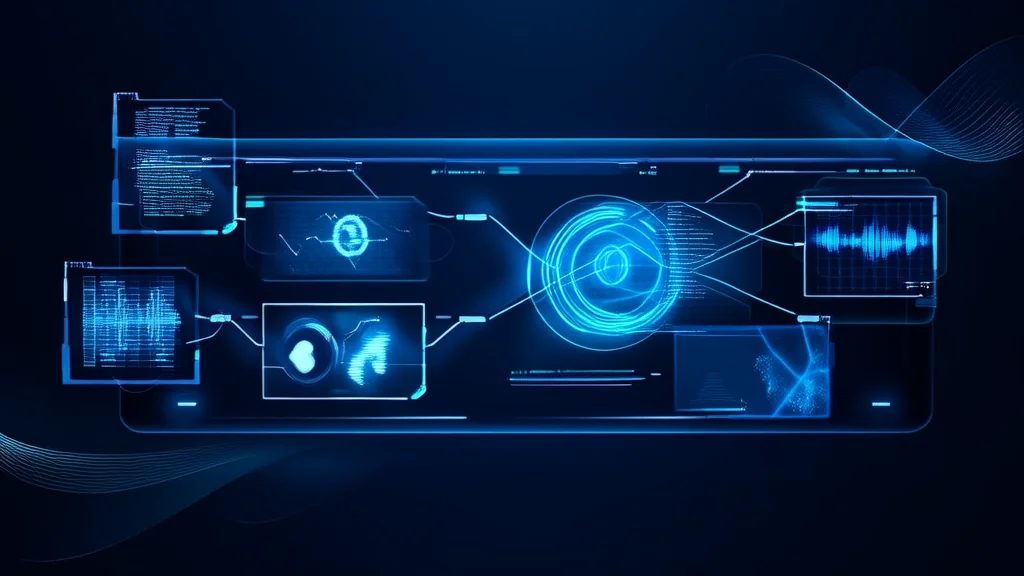
The core components of a multimodal AI system typically include encoders, fusion mechanisms, and decoders. Encoders transform raw data from each modality into a high-dimensional feature space. Fusion mechanisms combine these features in a way that preserves the relationships between different modalities. Decoders then generate the final output, which can be in any of the input modalities or a combination thereof. For instance, in a multimodal translation system, the encoder might process both text and images, the fusion mechanism would align these features, and the decoder would generate the translated text.
Multimodal AI differs from related technologies like unimodal AI and multimodal signal processing in several ways. Unimodal AI focuses on a single type of data, such as text or images, and does not leverage the complementary information from other modalities. Multimodal signal processing, on the other hand, often deals with the synchronization and alignment of multiple signals, but it does not necessarily involve the deep learning techniques used in multimodal AI. An analogy to help understand this is to think of unimodal AI as a person who can only see or only hear, while multimodal AI is a person who can see, hear, and understand the context of both.
Technical Architecture and Mechanics
The architecture of a typical multimodal AI system consists of several key components: encoders, a fusion layer, and decoders. Each component plays a specific role in the overall process. The encoders are responsible for transforming raw data from each modality into a high-dimensional feature space. For example, in a text-image multimodal system, a transformer model might be used to encode the text, while a convolutional neural network (CNN) might be used to encode the image. The fusion layer then combines these features, and the decoders generate the final output.
One of the most popular architectures for multimodal AI is the transformer-based model, which uses self-attention mechanisms to capture dependencies within and between modalities. For instance, in a transformer model, the attention mechanism calculates the relevance of each token in the input sequence to every other token, allowing the model to focus on the most relevant parts of the input. This is particularly useful in multimodal settings, where the model needs to understand the relationships between different types of data.
The fusion layer is a critical component of the architecture, as it determines how the features from different modalities are combined. There are several fusion strategies, including early fusion, late fusion, and hybrid fusion. Early fusion combines the features from different modalities at the input level, while late fusion combines the features at the output level. Hybrid fusion, on the other hand, combines features at multiple levels, providing a more flexible and robust approach. The choice of fusion strategy depends on the specific task and the nature of the data.
Key design decisions in multimodal AI include the choice of encoders, the fusion strategy, and the loss function. For example, the choice of encoders can significantly impact the performance of the system. Transformer models are well-suited for text and sequential data, while CNNs are effective for image and spatial data. The fusion strategy should be chosen based on the task requirements and the need for interpretability. Finally, the loss function should be designed to encourage the model to learn meaningful representations across modalities. For instance, contrastive loss functions, such as those used in CLIP, are effective for aligning text and image embeddings.
Technical innovations in multimodal AI include the use of pre-trained models, such as BERT for text and ResNet for images, which can be fine-tuned for specific tasks. This transfer learning approach reduces the amount of labeled data required and improves the generalization of the model. Another innovation is the use of cross-modal attention, which allows the model to focus on the most relevant parts of the input from different modalities. For example, in a visual question answering system, the model can use cross-modal attention to focus on the part of the image that is most relevant to the question.
Advanced Techniques and Variations
Modern variations of multimodal AI include the use of transformers with cross-modal attention, multi-modal transformers, and hierarchical fusion mechanisms. Transformers with cross-modal attention, such as the ones used in CLIP, have shown significant improvements in tasks like image-text retrieval and zero-shot classification. Multi-modal transformers, such as MMT (Multi-Modal Transformer), extend the transformer architecture to handle multiple modalities simultaneously, allowing for more efficient and effective fusion of features.
Hierarchical fusion mechanisms, such as those used in the Hierarchical Attention Network (HAN), provide a more structured approach to combining features from different modalities. These mechanisms allow the model to learn hierarchical representations, where lower-level features are combined to form higher-level abstractions. This is particularly useful for tasks that require a deep understanding of the context, such as video captioning and multimodal sentiment analysis.
Recent research developments in multimodal AI include the use of self-supervised learning, which allows the model to learn from large amounts of unlabeled data. For example, the DALL-E model, developed by OpenAI, uses a self-supervised approach to generate images from text descriptions. Another recent development is the use of graph neural networks (GNNs) for multimodal data, which can capture the structural relationships between different modalities. GNNs have been successfully applied to tasks like scene graph generation and multimodal knowledge graph completion.
Comparing different methods, transformers with cross-modal attention are generally more effective for tasks that require fine-grained alignment between modalities, such as image-text retrieval. Multi-modal transformers are better suited for tasks that require simultaneous processing of multiple modalities, such as video captioning. Hierarchical fusion mechanisms are effective for tasks that require a deep understanding of the context, such as multimodal sentiment analysis. The choice of method depends on the specific task and the nature of the data.
Practical Applications and Use Cases
Multimodal AI is used in a wide range of practical applications, from e-commerce and social media to healthcare and autonomous vehicles. One of the most prominent applications is in e-commerce, where multimodal AI is used to enhance product recommendations and search results. For example, Amazon uses multimodal AI to generate product descriptions and to improve the accuracy of image-based search. In social media, platforms like Facebook and Instagram use multimodal AI to analyze and moderate user-generated content, such as images and videos, to detect and remove inappropriate or harmful content.
In healthcare, multimodal AI is used for medical image analysis, patient monitoring, and clinical decision support. For example, multimodal AI can be used to analyze MRI and CT scans, along with patient records and lab results, to provide a more comprehensive diagnosis. In autonomous vehicles, multimodal AI is used to process sensor data from cameras, lidars, and radars, enabling the vehicle to make more informed and safe driving decisions. For instance, Tesla's Autopilot system uses multimodal AI to process data from multiple sensors and to generate driving instructions.
Multimodal AI is suitable for these applications because it can provide a more holistic and contextually rich understanding of the data. For example, in e-commerce, multimodal AI can analyze both the text and images of a product to provide more accurate and relevant recommendations. In healthcare, multimodal AI can integrate multiple types of medical data to provide a more comprehensive and accurate diagnosis. In autonomous vehicles, multimodal AI can process data from multiple sensors to make more informed and safe driving decisions.
Technical Challenges and Limitations
Despite its potential, multimodal AI faces several technical challenges and limitations. One of the main challenges is the alignment of different modalities, which requires the model to learn meaningful and consistent representations across modalities. This is particularly challenging when the data from different modalities are of different scales and have different distributions. For example, text and images have very different statistical properties, and aligning them requires sophisticated techniques like contrastive learning and cross-modal attention.
Another challenge is the computational requirements of multimodal AI systems. These systems often require large amounts of data and computational resources to train effectively. For example, training a multimodal transformer model like CLIP requires a large dataset of text-image pairs and significant computational power. This can be a barrier to entry for many researchers and organizations, especially those with limited resources.
Scalability is another issue, as multimodal AI systems need to be able to handle large and diverse datasets efficiently. This requires the development of scalable and efficient algorithms and architectures. For example, hierarchical fusion mechanisms can help to scale up the system by providing a more structured approach to combining features from different modalities. However, these mechanisms can also introduce additional complexity and computational overhead.
Research directions addressing these challenges include the development of more efficient and scalable algorithms, the use of self-supervised learning, and the exploration of new fusion mechanisms. For example, self-supervised learning can help to reduce the amount of labeled data required and improve the generalization of the model. New fusion mechanisms, such as graph-based approaches, can provide more flexible and efficient ways to combine features from different modalities.
Future Developments and Research Directions
Emerging trends in multimodal AI include the use of self-supervised learning, graph neural networks, and multimodal generative models. Self-supervised learning is a promising approach that allows the model to learn from large amounts of unlabeled data, reducing the need for labeled data and improving the generalization of the model. Graph neural networks (GNNs) are being explored for their ability to capture the structural relationships between different modalities, making them suitable for tasks like scene graph generation and multimodal knowledge graph completion. Multimodal generative models, such as DALL-E, are capable of generating high-quality images from text descriptions, opening up new possibilities for creative and interactive applications.
Active research directions in multimodal AI include the development of more efficient and scalable algorithms, the exploration of new fusion mechanisms, and the application of multimodal AI to new domains. For example, researchers are working on developing more efficient and scalable algorithms for training multimodal transformers, which can handle large and diverse datasets. New fusion mechanisms, such as hierarchical and graph-based approaches, are being explored to provide more flexible and efficient ways to combine features from different modalities. Additionally, multimodal AI is being applied to new domains, such as robotics and human-computer interaction, where it can provide a more natural and intuitive way to interact with machines.
Potential breakthroughs on the horizon include the development of multimodal AI systems that can handle a wider range of modalities and tasks, and the integration of multimodal AI with other emerging technologies, such as quantum computing and neuromorphic computing. These breakthroughs could lead to more powerful and versatile AI systems that can better understand and interact with the world. Industry and academic perspectives on multimodal AI are increasingly focused on the practical applications and the ethical and societal implications of these technologies. As multimodal AI continues to evolve, it will be important to address these issues and ensure that the technology is developed and deployed in a responsible and ethical manner.