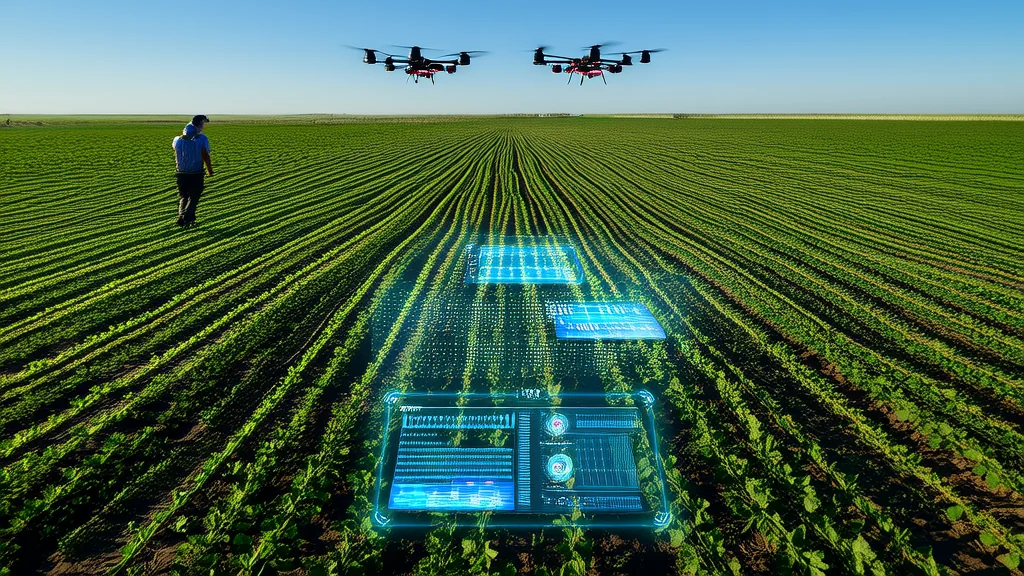
Opening Hook
According to the United Nations, the world's population is projected to reach 9.7 billion by 2050, putting immense pressure on the agricultural sector to produce more food with fewer resources. This challenge is compounded by climate change, which is making traditional farming methods increasingly unsustainable. Enter Artificial Intelligence (AI), a transformative technology that is revolutionizing precision agriculture and crop yield optimization. By leveraging AI, farmers can make data-driven decisions, reduce waste, and increase productivity, ultimately ensuring food security for future generations.
Industry Context and Market Dynamics
The global precision agriculture market was valued at approximately $6.8 billion in 2021 and is expected to grow at a compound annual growth rate (CAGR) of 13.8% from 2022 to 2028, reaching $16.4 billion by 2028. This growth is driven by the increasing need for efficient and sustainable farming practices, as well as the rising adoption of advanced technologies like AI, IoT, and big data analytics. Key pain points in the industry include high operational costs, inefficient resource management, and the impact of climate change on crop yields. AI addresses these issues by providing real-time data analysis, predictive insights, and automated decision-making, enabling farmers to optimize their operations and maximize profits.
The competitive landscape in the AI-driven precision agriculture market includes both established tech giants and innovative startups. Companies like Microsoft, IBM, and Google are investing heavily in AI solutions for agriculture, while startups such as CropX, FarmWise, and Taranis are gaining traction with specialized, niche solutions. The market is characterized by a mix of hardware, software, and service offerings, each tailored to address specific challenges in the agricultural value chain.
In-Depth Case Studies
Case Study 1: John Deere and Blue River Technology
Company Name: John Deere
Specific Problem Solved: Inefficient use of herbicides and labor-intensive weed control
AI Solution Implemented: John Deere acquired Blue River Technology in 2017 and integrated its See & Spray technology into their tractors. This AI-powered system uses computer vision and machine learning to identify and target weeds, applying herbicides only where needed. The system can differentiate between crops and weeds, reducing herbicide use by up to 90%.
Measurable Results: In field trials, the See & Spray system reduced herbicide usage by 87%, leading to significant cost savings and environmental benefits. Additionally, the system increased the efficiency of weed control, allowing farmers to manage larger areas with fewer resources. The implementation timeline was approximately 12 months, including integration with existing John Deere equipment and training for farmers.
Case Study 2: CropX and Microsoft Azure
Company Name: CropX
Specific Problem Solved: Inefficient water usage and poor soil health monitoring
AI Solution Implemented: CropX partnered with Microsoft Azure to develop an AI-driven soil health and water management platform. The solution uses sensors to collect real-time data on soil moisture, temperature, and nutrient levels. Machine learning algorithms then analyze this data to provide actionable insights, such as optimal irrigation schedules and fertilizer application recommendations.
Measurable Results: In a pilot project with a large-scale farm in California, the CropX platform reduced water usage by 40% and increased crop yields by 10%. The platform also helped the farm save $15,000 per acre in input costs. The implementation took about 6 months, including sensor installation, data collection, and integration with the farm's existing systems.
Case Study 3: Taranis and Computer Vision
Company Name: Taranis
Specific Problem Solved: Early detection of crop diseases and pests
AI Solution Implemented: Taranis developed an AI-powered platform that uses high-resolution aerial imagery and computer vision to detect early signs of crop stress, diseases, and pests. The platform analyzes images from drones and satellites, providing farmers with real-time alerts and recommendations for targeted interventions.
Measurable Results: In a case study with a soybean farm in Brazil, Taranis' platform detected a fungal disease outbreak two weeks earlier than traditional scouting methods. This early detection allowed the farm to apply fungicides in a timely manner, preventing a 30% yield loss. The implementation timeline was approximately 3 months, including drone and satellite imagery setup, data processing, and farmer training.
Technical Implementation Insights
The key AI technologies used in these case studies include computer vision, machine learning, and natural language processing (NLP). For example, John Deere's See & Spray system uses deep learning algorithms to classify plants and weeds, while CropX's platform employs time-series analysis and predictive modeling to forecast soil conditions. These technologies are often integrated with IoT devices, such as sensors and drones, to collect and transmit real-time data.
Implementation challenges include data quality and availability, as well as the need for robust and scalable infrastructure. For instance, Taranis had to ensure that the aerial imagery was of high enough resolution to accurately detect crop stress. To address these challenges, companies often partner with cloud providers like Microsoft Azure or Amazon Web Services (AWS) to leverage their computing power and storage capabilities. Performance metrics, such as accuracy, precision, and response time, are critical for evaluating the effectiveness of AI solutions in agriculture.
Business Impact and ROI Analysis
The business impact of AI in precision agriculture is significant. In the case of John Deere, the See & Spray system not only reduced herbicide usage but also lowered labor costs and improved crop yields. Similarly, CropX's platform provided substantial cost savings and increased revenue through optimized water and fertilizer use. Taranis' early detection system prevented yield losses and reduced the need for costly interventions.
Return on investment (ROI) for these AI solutions can be substantial. For example, a 40% reduction in water usage and a 10% increase in crop yields, as seen in the CropX case, can translate to millions of dollars in savings and additional revenue for large-scale farms. As more farmers adopt AI-driven precision agriculture, the market is expected to see continued growth, driven by the clear financial and operational benefits.
Challenges and Limitations
Despite the promising results, there are several challenges and limitations to implementing AI in agriculture. Technical challenges include the need for high-quality data, which can be difficult to obtain in remote or underdeveloped regions. Additionally, the integration of AI solutions with existing farm equipment and systems can be complex and time-consuming. Regulatory and ethical considerations, such as data privacy and the potential for job displacement, also need to be addressed.
Industry-specific obstacles include the variability of weather and soil conditions, which can affect the performance of AI models. For example, a model trained on data from one region may not perform well in another region with different climatic conditions. Addressing these challenges requires ongoing research and development, as well as collaboration between technology providers, farmers, and regulatory bodies.
Future Outlook and Trends
Emerging trends in AI-driven precision agriculture include the use of edge computing, which allows for real-time data processing and decision-making on the farm. This can significantly reduce latency and improve the responsiveness of AI systems. Additionally, the integration of AI with other emerging technologies, such as blockchain and robotics, is expected to further enhance the efficiency and sustainability of agricultural practices.
Over the next 2-3 years, we can expect to see increased investment in AI for agriculture, driven by the growing demand for food and the need for more sustainable farming methods. Potential new applications include the use of AI for crop breeding, supply chain optimization, and consumer engagement. Market growth projections indicate that the global precision agriculture market will continue to expand, with AI playing a central role in driving innovation and efficiency in the sector.